
Building Regulations 10-Year Rule Explained: What the Law Really Says
The building regulations 10-year rule is one of the most misunderstood areas of property law in England. Many homeowners assume building work automatically becomes legal once it has been in place for ten years. However, that is not how the law works.
Much of the confusion comes from changes to both planning enforcement and building control. Planning law now generally gives councils ten years to act against new breaches, while the Building Safety Act extended the period for serving certain building regulations enforcement notices from 12 months to ten years.
These rules have different purposes and legal effects. In this guide, we explain what changed, which time limits may apply and what to do if your property does not have the correct planning or building regulations documentation.

Is There a Building Regulations 10-Year Rule?
Yes, but not in the way many people think.
No rule automatically makes unauthorised or non-compliant building work acceptable after ten years. Instead, the ten-year period limits when a local authority can use a particular enforcement power.
Section 39 of the Building Safety Act 2022 extended the time available to serve a Section 36 notice requiring non-compliant work to be altered or removed. The previous time limit was 12 months. In England, it is now ten years.
This represents a significant increase in the time available for enforcement, but it does not mean work receives retrospective approval after ten years.
Once the period has passed, the property owner will not automatically receive:
Building regulations approval
A Completion Certificate
Confirmation that the work is structurally safe
Evidence that the work met the regulations in force when it was completed
A property can therefore become lawful for planning purposes while still raising questions about building regulations compliance.
Planning Permission vs Building Regulations
Planning permission and building regulations are often discussed together, but they serve different purposes.
Put simply, planning permission determines what can be built, while building regulations determine how it should be built.
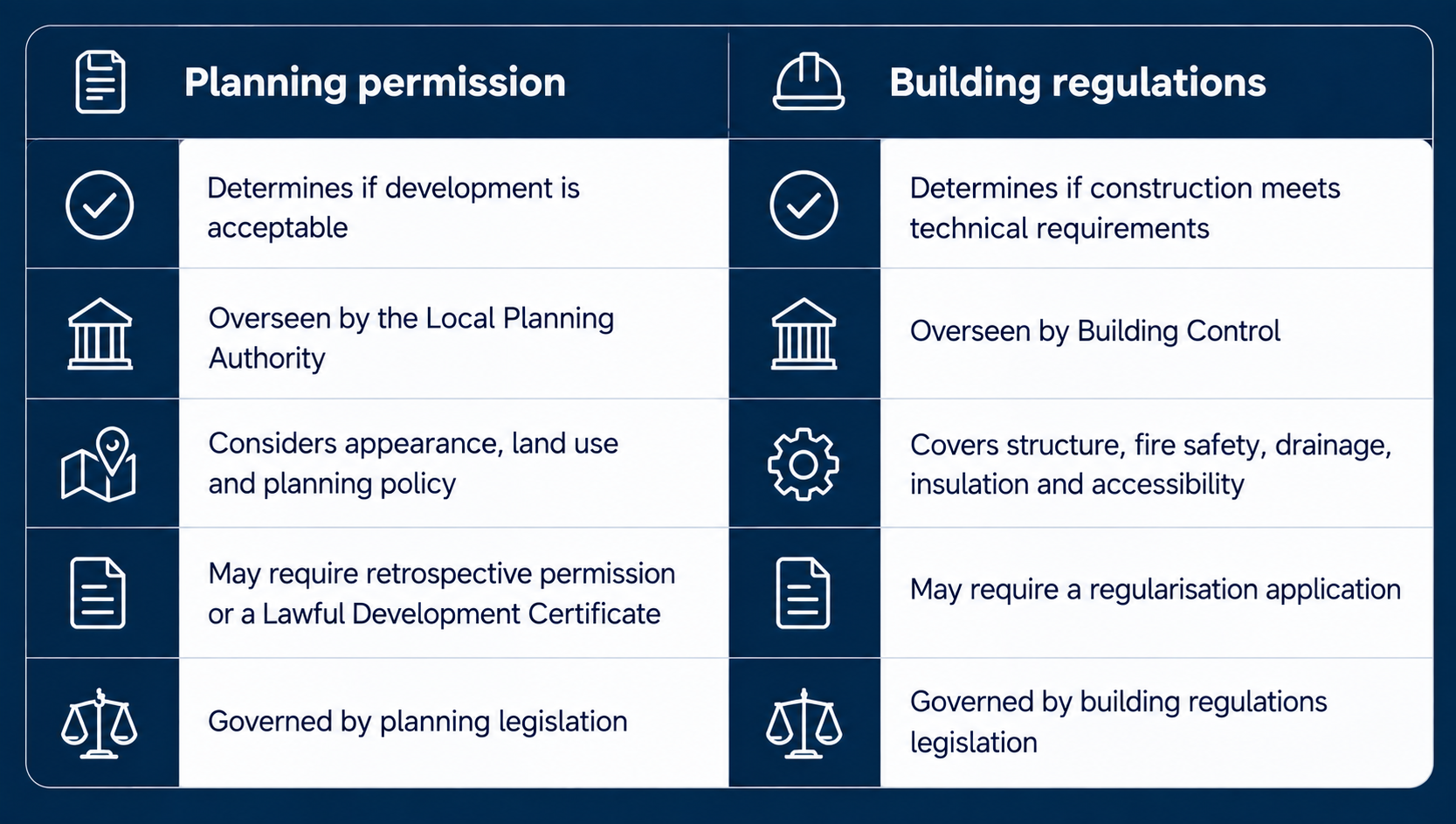
Many projects require approval under both systems. Others may only require one.
This is where homeowners can run into difficulties, particularly when purchasing an older property where certificates are missing or a previous owner completed work without obtaining the necessary approvals.
Does the Old Four-Year Planning Rule Still Apply?
In some cases, yes. The date the unauthorised development was substantially completed determines which planning enforcement period may apply.
The transitional arrangements are explained in the Dorset Council Development Management Local Enforcement Plan.
For operational development such as an extension or new building:
Work substantially completed before 25 April 2024 may remain subject to the previous four-year period.
Work substantially completed on or after 25 April 2024 is generally subject to the new ten-year period.
The same transitional distinction applies to the unauthorised change of use of a building into a single dwellinghouse.
Other planning breaches, such as certain changes of use and breaches of planning conditions, were already subject to a ten-year enforcement period.
What Was the Four-Year Rule?
Under the previous planning system, councils generally had four years to take enforcement action against unauthorised operational development, including extensions and new buildings.
The same period applied when a building had been converted into a single dwelling without the necessary planning permission.
Once the relevant period had passed without enforcement, the development could potentially become immune from planning enforcement. However, the property owner would still normally need to provide sufficient evidence and apply for a Lawful Development Certificate to confirm its status formally.
What Changed on 25 April 2024?
Section 115 of the Levelling-up and Regeneration Act extended the planning enforcement period for operational development and conversion to a single dwellinghouse from four years to ten years in England.
The change is explained in the government’s Explanatory Notes to the Levelling-up and Regeneration Act 2023.
For development falling under the new rules, local planning authorities generally have ten years to begin enforcement action.
This does not mean planning permission is automatically granted at the end of the period. Instead, the development may become immune from enforcement if all the relevant legal requirements are satisfied.

What Happens After the Ten-Year Planning Period?
If the relevant period expires without enforcement, the development may become lawful for planning purposes.
However, the passage of time alone is not always enough. The property owner will normally need to demonstrate when the development was completed or when the unauthorised use began.
There are also important exceptions. Unauthorised work to a listed building is subject to separate controls. Deliberately concealed development can also remain open to enforcement after the usual deadline.
The Dorset Council enforcement plan explains that a council can apply for a Planning Enforcement Order where positive steps have been taken to conceal unauthorised development.
The application must be made within six months of sufficient evidence coming to the council’s attention. If an order is granted, the council may receive a further 12 months to investigate and take action.
What Does the Ten-Year Rule Mean for Homeowners?
The main takeaway is that time alone does not solve planning or building regulations problems.
If work was completed without planning permission, the local planning authority may still be able to take action if the development falls within the relevant enforcement period. Even after that period has expired, the owner may need to prove that the development has become lawful.
Missing building regulations approval does not disappear simply because a project was completed many years ago. Missing certificates frequently come to light when a property is sold, remortgaged, surveyed or altered.
The absence of paperwork can result in:
Additional conveyancing enquiries
Delays to a property sale
Concerns from mortgage lenders
Requests for structural or safety investigations
The need for retrospective drawings or calculations
A regularisation application
Alterations to completed work
Can You Always Rely on the Ten-Year Planning Rule?
Not automatically.
The planning rule is not something a property owner can claim simply because a building has existed for ten years. Evidence is normally required to establish when the development was substantially completed or when the unauthorised use began.
Useful evidence may include:
Council tax records
Utility bills
Dated photographs
Tenancy agreements
Insurance documents
Building invoices
Aerial or satellite images
Statutory declarations from previous owners or neighbours
The evidence should be precise, consistent and cover the relevant period. Gaps or contradictions can make it more difficult to prove that the development is lawful.

Retrospective Planning Permission vs a Lawful Development Certificate
If work has already been completed without planning permission, there are two common ways to address the planning position: applying for retrospective planning permission or obtaining a Lawful Development Certificate.
When Should You Apply for Retrospective Planning Permission?
Retrospective planning permission is used when development has already been completed without the required planning consent.
The local planning authority assesses the completed development against current planning policies in much the same way as a normal application.
If permission is granted, the development receives formal planning approval. If the application is refused, the authority may require changes or consider enforcement action.
Submitting an application does not guarantee that permission will be granted.
When Is a Lawful Development Certificate More Appropriate?
A Lawful Development Certificate does not grant planning permission.
Instead, it formally confirms that an existing development or use is lawful under planning legislation. This may be appropriate where the relevant planning enforcement period has expired and sufficient evidence is available.
A certificate can be particularly valuable before selling or remortgaging a property because it gives buyers, mortgage lenders and solicitors formal evidence of the planning position.
An LDC only confirms the planning status of the property. It does not confirm compliance with building regulations or replace a building control Completion Certificate.
Which Planning Option Is Right for Your Property?
The right approach depends on when the development was completed, what permission should have been obtained and what evidence is available.
If the work remains within the planning enforcement period, retrospective planning permission may be the appropriate route.
If the relevant period has expired and the development meets the legal requirements, a Lawful Development Certificate may be more suitable.
Before making either application, it is important to understand the potential risks. For example, contacting the council or submitting an application can bring unauthorised work to its attention. Professional advice can help you assess the position before taking action.
What Happens If Building Regulations Are Ignored?
Building regulations have a separate enforcement system from planning permission.
The Building Safety Act extended the period in which a local authority can serve a Section 36 notice requiring non-compliant work to be altered or removed from 12 months to ten years.
According to Lancaster City Council’s guidance on building regulations changes, a Section 36 notice can be issued up to ten years after the completion of the work. The same guidance states that prosecution may also be possible up to ten years after completion of the offending work. Depending on the circumstances, the consequences can include remedial work, prosecution and an unlimited fine.
These enforcement powers do not mean every technical breach will lead to prosecution. Councils will consider the facts, the seriousness of the problem and any risk to people using the building.
However, planning immunity does not remove concerns about structural safety, fire protection, insulation, drainage or other building regulations requirements.

Can a Notice Still Be Enforced After Ten Years?
Potentially, yes.
The ten-year deadline relates to when a Section 36 notice can be served. It does not necessarily create a ten-year deadline for enforcing a notice that has already been issued.
The LABC Enforcement Policy for England and Wales refers to Bello v London Borough of Lewisham. In that case, the removal of a building regulations contravention was enforced approximately 12 years after the original Section 36 notice had been served.
This means property owners should not assume an existing notice has disappeared simply because the work or notice is more than ten years old.
What Should You Do If You Receive a Section 36 Notice?
A Section 36 notice should not be ignored.
Lancaster City Council’s building regulations guidance states that an appeal may need to be made within 21 days. Property owners should therefore obtain appropriate professional and legal advice as soon as a notice is received.
If the notice is not complied with, the local authority may carry out the necessary alterations or removal work and recover the cost from the property owner.
The LABC enforcement policy also explains that enforcement costs may be recovered from the owner or recorded as a charge on the Local Land Charges register. Unpaid charges may accrue interest.
Can Building Work Be Regularised After It Is Completed?
If building work was completed without the necessary building regulations application, the owner may be able to apply to the local authority for a Regularisation Certificate.
Regularisation is generally available for unauthorised work started on or after 11 November 1985. This date is confirmed in Guildford Borough Council’s building control guidance.
The work will generally be assessed against the building regulations that applied when it was carried out.
If Building Control is satisfied that the work complies, a Regularisation Certificate may be issued. If the work does not meet the applicable requirements, alterations may be needed before a certificate can be provided.
What Evidence Is Needed for Regularisation?
A regularisation application is not simply a paperwork exercise.
Building Control may require:
Existing and proposed drawings
Construction details
Structural calculations
Drainage information
Electrical or gas certificates
Details of insulation and ventilation
Evidence of fire protection
Photographs taken during construction
Parts of the finished building may also need to be opened up so concealed work can be inspected.
The current Basingstoke and Deane Building Control fee guidance warns applicants that they may have to expose critical parts of the construction and provide calculations so Building Control can assess compliance.
This could involve opening floors, walls or ceilings to inspect foundations, structural beams, insulation, drainage or fire protection.

How Much Does Regularisation Cost?
Regularisation charges are set locally, so there is no single national price.
The fee is often higher than the cost of applying before the work begins because Building Control may need to assess completed and concealed construction.
As a current example, Wandsworth Borough Council’s 2026 building control charges list a regularisation charge of £1,104 for an extension of up to 40 square metres and £1,083.60 for a loft conversion of the same size.
These are local examples rather than Cornwall prices. Homeowners should check Cornwall Council’s current charges before applying.
There may also be additional costs for:
Measured surveys
Architectural drawings
Structural calculations
Specialist inspections
Opening up completed work
Remedial building work
It is sensible to establish what information is likely to be required before submitting an application.
Can You Sell a Property Without a Completion Certificate?
A property can be sold without a building regulations Completion Certificate, but the missing documentation may complicate the transaction.
The buyer’s solicitor or mortgage lender may ask:
Why the certificate is missing
When the work was completed
Which contractor carried it out
If the work was inspected
If structural calculations are available
If the work can be regularised
If indemnity insurance is appropriate
Indemnity insurance may sometimes be considered during conveyancing, but it does not confirm that the work is safe or compliant. Contacting the council before obtaining a policy may also affect the availability of insurance.
Property owners should take advice from their solicitor or conveyancer before approaching Building Control where a sale is in progress.
Need Advice on Planning Permission or Building Regulations Approval?
Understanding the building regulations 10-year rule is only part of the picture. The correct route depends on the type of development, when it was completed, which approvals are missing and what evidence is available.
At Atlantek Architects, we help homeowners across Cornwall with planning applications, building regulations and residential design.
We can help assess the available information, prepare the drawings and documentation needed for an application and explain the likely next steps for your property.
Contact us to discuss your project or find out how we can help with planning compliance and building regulations.
Frequently Asked Questions
Can building regulations be enforced after ten years?
A new Section 36 notice is generally subject to a ten-year limit from completion of the work. However, a notice served within that period may remain enforceable after ten years have passed. Other safety and legal powers may also apply depending on the circumstances.
Does building work automatically become legal after ten years?
No. The expiry of an enforcement period does not provide building regulations approval, confirm that the work is safe or produce a Completion Certificate.
Can I sell my house without a building regulations certificate?
Yes, but it may complicate the sale. Buyers’ solicitors and mortgage lenders often request a Completion Certificate. Missing documentation can lead to additional enquiries, delays or requests for further investigations.
What happens if building work was never signed off?
You may not have a Completion Certificate confirming that the work met the relevant requirements. Depending on the circumstances, you may need to provide additional evidence, obtain professional reports or apply for regularisation.
When did the ten-year planning rule start?
The new ten-year planning enforcement period came into effect in England on 25 April 2024. Transitional arrangements mean the previous four-year period may still apply to certain development completed before that date.
Does planning permission matter after ten years?
Yes. Development may become immune from planning enforcement after the relevant period, but planning permission is not automatically granted. A Lawful Development Certificate may be needed to confirm the property’s planning status formally.
Is planning law the same across the UK?
No. This guide covers England. Different legislation and enforcement periods may apply in Wales, Scotland and Northern Ireland.
Can old building work be regularised?
Regularisation is generally available for unauthorised work started on or after 11 November 1985. Building Control may require drawings, calculations, inspections, opening-up work and alterations before issuing a certificate.