
Planning Permission Cornwall Guide: A Practical Walkthrough
Applying for planning permission in Cornwall can feel like a daunting task. There are policies, procedures, timescales, and terminology that make even the most straightforward project feel more complicated than it needs to be. Understanding how the system works is the first step to a smoother experience.
This guide is designed to give you a clear understanding of what to expect, what to avoid, and how to give your construction or renovation project the best chance of success.
Here's what we'll cover:
When you need planning permission in Cornwall
Permitted development rights and what they cover
The step-by-step planning application process
Cornwall Council's requirements and local policies
Fees, timescales, and consultation periods
Common pitfalls and how to avoid them
Special considerations for AONBs, conservation areas, and listed buildings
At Atlantek Architects, we help clients across Cornwall move confidently through the planning process every day. If you'd like professional support with your project, book a free consultation with our team, and we'll walk you through the options.
When Do You Need Planning Permission in Cornwall?
Not every building project needs planning permission. Some smaller works fall under permitted development rights, meaning you can proceed without a formal planning application. Others always need approval, regardless of scale.
You'll typically need planning permission for:
New builds and self-build homes
Larger extensions beyond permitted development limits
Changes of use (e.g., agricultural to residential)
Any work to listed buildings
Development in conservation areas or AONBs
Works affecting neighbouring boundaries or amenities
Building shepherd's huts, annexes, or outbuildings above certain sizes
Commercial projects and larger developments
If you're unsure, the safest first step is either a Certificate of Lawfulness application or a professional appraisal from an architectural practice familiar with Cornwall Council's approach. Getting this right at the start prevents expensive mistakes later.
Understanding Permitted Development Rights
Permitted development rights allow certain types of work to be carried out without applying for planning permission. These rights are set nationally through the General Permitted Development Order but can be restricted locally, particularly in conservation areas, AONBs, or by Article 4 directions.
Common permitted development scenarios in Cornwall:
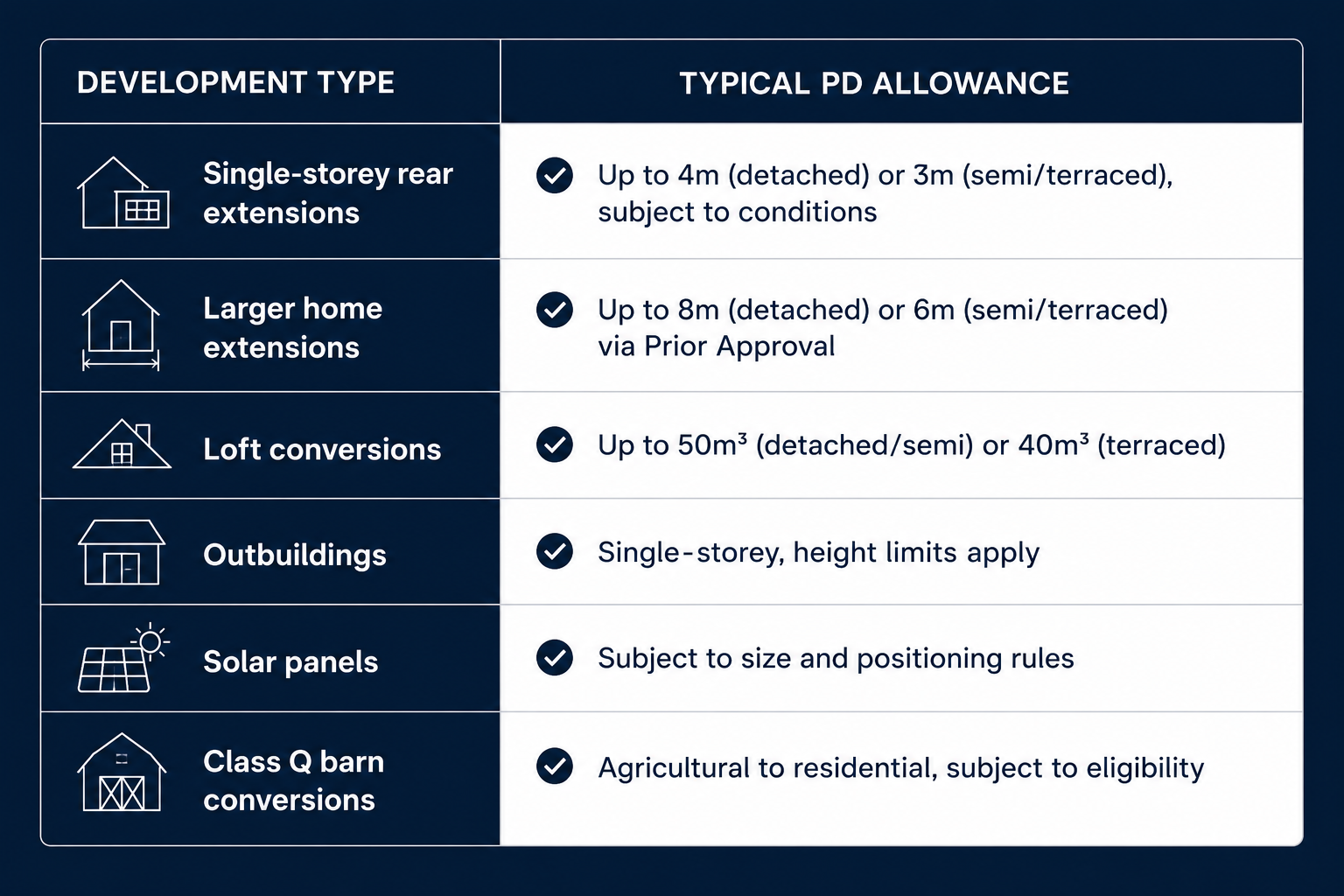
Permitted development rights don't apply in every circumstance. Properties in AONBs, conservation areas, listed buildings, and homes with Article 4 directions in place may lose some or all PD rights. Always check with Cornwall Council or an architect before assuming your project doesn't need permission.
The Planning Application Process Step by Step
Understanding the planning process helps you plan realistic timescales and avoid nasty surprises. Here's what typically happens from first idea to decision.
Step 1: Initial Design and Feasibility
Before spending money on a formal application, it's worth conducting a feasibility study to assess your site's potential. This looks at planning policies, site constraints, access, orientation, and budget implications. Getting this stage right gives you a clear foundation for the rest of the project.
Step 2: Pre-Application Advice
Cornwall Council offers a formal pre-application advice service, and it's often a smart investment for anything beyond the most straightforward project. Early engagement with a planning officer helps you understand what's likely to be acceptable, what issues might arise, and how to shape a successful proposal.
According to Cornwall Council's pre-application service, fees vary by project type. Householder pre-application enquiries receive a desktop assessment, while larger schemes attract higher fees and can include site visits and consultations.
Step 3: Preparing Your Planning Application
Cornwall planning applications are submitted through the Planning Portal. You'll need:
Completed application forms for the relevant application type
Location and site plans at recognised scales
Existing and proposed elevations, floor plans, and sections
Design and Access Statement (where required)
Heritage Statement for listed buildings or conservation areas
Additional supporting reports as needed (ecology, flood risk, landscape, etc.)
The correct fee
Cornwall Council maintains a validation guide setting out exactly what's needed. Missing information leads to invalid applications, delays, and frustration. This is where working with an accredited agent or experienced architect saves real time.
Step 4: Validation and Consultation
Once submitted, your application is validated by Cornwall Council. Once accepted, a consultation period begins during which neighbours, town councils, statutory consultees, and other interested parties can comment.
Step 5: Assessment and Decision
The planning officer assesses the proposal against local policies, national planning policy, supplementary planning documents, neighbourhood plans, and material planning considerations. A recommendation is then made, with smaller schemes decided under delegated authority and larger ones going to the committee.
Typical decision timescales:
Householder applications: 8 weeks
Minor applications: 8 weeks
Major applications: 13 weeks (or longer for complex schemes)
Cornwall Council's Requirements and Local Policies
Cornwall Council operates under the Cornwall Local Plan, supported by supplementary planning documents and neighbourhood plans developed by town and parish councils. These set out local priorities including landscape sensitivity, affordable housing requirements, sustainable development, environmental protection, and heritage considerations.
Key local factors that shape planning decisions in Cornwall:
Cornwall AONB designation across coastal and moorland areas
Cornwall and Isles of Scilly World Heritage Site covering former mining landscapes
Conservation areas in many historic towns and villages
Listed buildings protected under national heritage legislation
Flood risk in low-lying and coastal areas
Landscape character and how development affects wider views
Principal residence policy apply in some parts of Cornwall, such as St Ives, where local planning policies place restrictions on new open-market dwellings being used as second homes.
Class Q conversions for agricultural buildings
Local town and parish councils often have their own neighbourhood plans that add further requirements. Understanding these local policies early is essential for a successful application.
Planning Application Fees in Cornwall
Planning application fees are set nationally by the Government and are typically updated each year. Statutory fees increased by 3.8% on 1 April 2026, with common applications including householder projects (such as extensions and alterations) from around £548 and new dwellings from around £610 per dwelling.
Fees for change of use applications and Lawful Development Certificates vary depending on the proposal, while Listed Building Consent remains free. As fees are subject to change, we always recommend checking the latest charges on the Planning Portal or Cornwall Council's planning fees page before submitting your application.
Special Considerations in Cornwall
Cornwall has more sensitive planning contexts than most parts of the UK. Getting these right takes careful navigation and local knowledge.
Areas of Outstanding Natural Beauty (AONBs)
The Cornwall AONB covers roughly a third of the county. Development in AONBs must respect landscape character and often faces stricter design controls. Materials, scale, and siting all get scrutinised more heavily.
Conservation Areas
Cornwall has over 140 conservation areas, from historic port towns to rural villages. Additional controls apply, including on demolition, tree work, and external alterations. Article 4 directions may remove permitted development rights entirely.
Listed Buildings
Any alterations to listed buildings require Listed Building Consent, in addition to any planning permission. Even minor internal changes may need consent, and unauthorised works are a criminal offence.
Flood Risk
Coastal and low-lying properties may sit within flood risk zones. Applications in these areas need a Flood Risk Assessment and mitigation strategies. The Environment Agency is a statutory consultee.
Class Q Barn Conversions
Class Q permitted development rights allow certain agricultural buildings to be converted to residential use, subject to prior approval. Eligibility is strict, and Cornwall's rural landscape means this is a popular route worth exploring.

Building Regulations vs Planning Permission
Planning permission and Building Regulations are two separate approvals, and both usually apply to major projects. Understanding the difference is essential.
Planning permission deals with the appearance, size, and impact of your development
Building Regulations ensure the work meets safety, structural, fire, energy efficiency, and accessibility standards
Some projects need one but not the other. Most substantial construction projects need both. Building Control approval is separate from planning approval, and Building Regulation guidance is available through Cornwall Council or private Building Control providers.
Common Pitfalls and How to Avoid Them
Even straightforward applications go wrong when key details are missed. Here are the mistakes we see most often, and how to sidestep them.
Skipping pre-application advice, then getting refused for issues that could have been fixed early
Submitting invalid applications with missing plans or documents
Underestimating conservation and AONB constraints on materials, scale, and design
Ignoring neighbour concerns, then facing objections during the consultation period
Assuming permitted development applies, only to find Article 4 restrictions in place
Not addressing supplementary planning documents or neighbourhood plans
Choosing an inexperienced designer who doesn't understand Cornwall's specific requirements
Working with a local architect who knows Cornwall Council's requirements makes a real difference. We spend our days working within these processes, and we know what makes an application land well.
How Long Does the Process Take?
Timescales vary based on project complexity and Cornwall Council's current workload. Here's a realistic guide.
Feasibility and design: 4 to 12 weeks
Pre-application advice: 4 to 8 weeks
Validation: 1 to 3 weeks
Consultation period: 21 days minimum
Decision on householder or minor applications: 8 weeks from validation
Decision on major applications: 13 weeks from validation
Complex applications with committee input: 4 to 6 months or more
The whole process, from first sketch to decision, typically takes 4 to 9 months for straightforward projects. Larger or more sensitive schemes can take a year or more. Planning ahead pays real dividends.
Getting Professional Support With Your Planning Application
The Cornwall planning system rewards careful navigation and clear understanding. Working with an experienced architectural practice removes much of the stress and greatly improves your chances of a successful outcome. From feasibility assessment through design, submission, and discharge of planning conditions, we handle the process from start to finish.
At Atlantek Architects, we support clients across Cornwall with residential and commercial projects, listed building work, coastal developments, and rural conversions. We know Cornwall Council, we know the local policies, and we know how to shape a proposal that lands well.
Ready to Get Started?
Every planning journey starts with a conversation. If you're thinking about a construction or renovation project in Cornwall, or you'd like practical advice on your specific site, we'd love to hear from you. Our free consultation gives you a clear understanding of your options before you commit to anything.
Atlantek Architects Homeland, Trevarren, St Columb, Cornwall
Phone: 01637 838152